Prisons of Personality

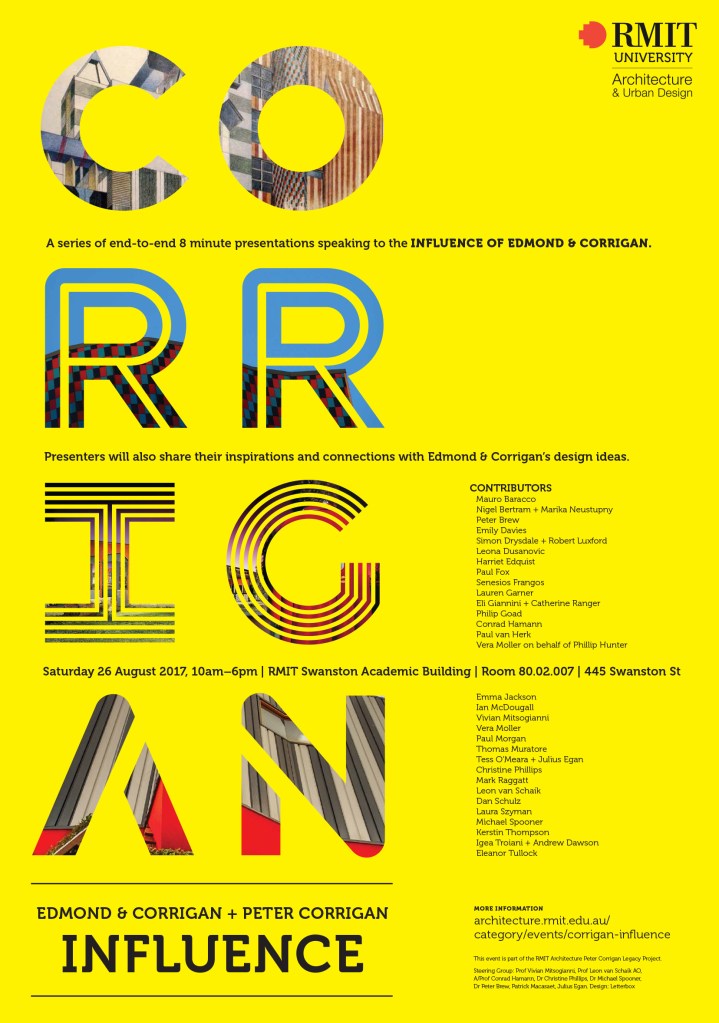
A spoken-word celebration of the generous cosmopolitanism of the late Professor Peter Corrigan, through the Meyer House by Edmond + Corrigan. This was presented at the event Influence: Edmond & Corrigan + Peter Corrigan hosted by RMIT Architecture in 2017. The speech was later published in the eponymous book.

If I were an island of lattes and smashed avocados I would buy a Victorian terrace on Canning St in Carlton and re-paint it cream, forest green and maroon – the colours of time.

If I were an island I’d want the neighbouring Bond-villian lair with the off form concrete and glazed garage door behind which glistens the holy Maserati. I can already feel the suede bathrobes on my skin, the Aesop toilet spritzer in my nostrils and the stainless steel strip drain recessed flush into hydronically-heated concrete on the soles of my feet. I’m salivating just talking about it.

If I were a 14 year old island again, this would be my urban fantasy. Here is me, incidentally, as a 14 year old island dreaming of that spacious penthouse and my very own jaguar one day.

But I’m an architect, not an island.

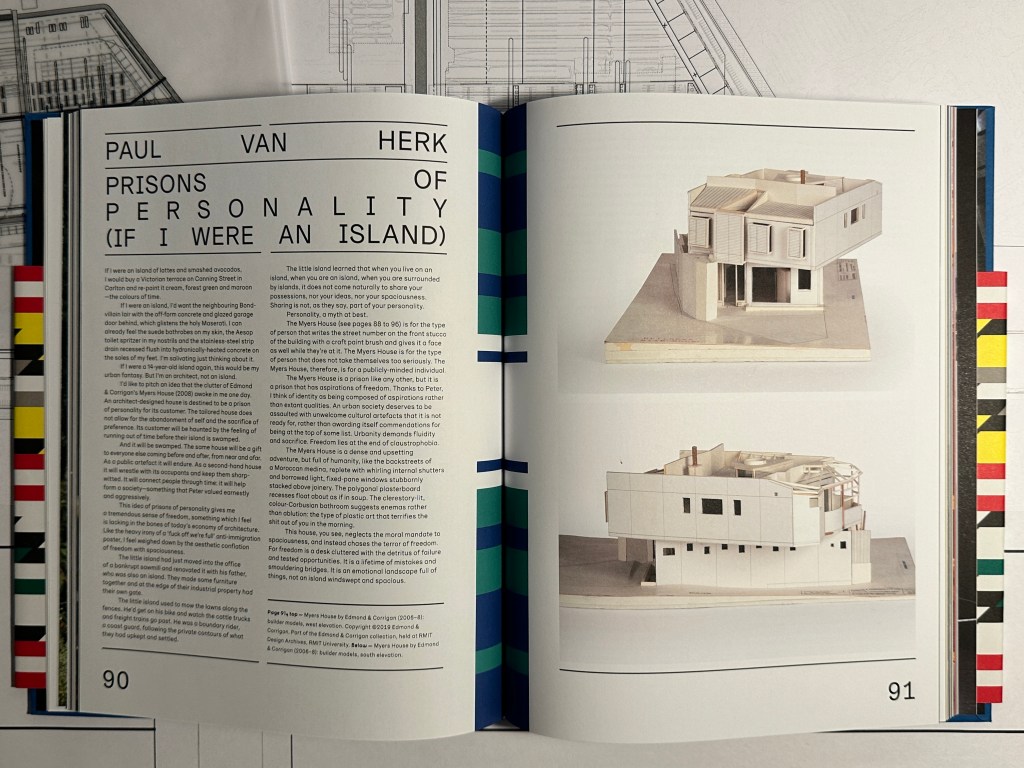
And I’m coming here today to pitch an idea that the internal clutter of Edmond and Corrigan’s Myers house (2008) awoke in me one day. at is: An architect-designed house is destined to be a prison of personality for its customer. The tailored house does not allow for the abandonment of self and the sacrifice of preference. Its customer will be haunted by the feeling of running out of time before their island is swamped.

And it will be swamped. the same house will be a gift to everyone else coming before and after, from near and afar. As a public artefact it will endure. As a second-hand house it will wrestle with its occupants and keep them sharp witted. It will connect people through time: it will help form a society – something that Peter valued earnestly and aggressively.

This idea of prisons of personality gives me a tremendous sense of freedom, something which I feel is lacking in the bones of today’s economy of architecture. Like the heavy irony of a ‘fuck off we’re full’ anti-immigration poster, I feel weighed down by the aesthetic conflation of freedom with spaciousness.

This is a picture of our 14 year old island’s bedroom. The little island had just moved into the abandoned office of a bankrupt sawmill and renovated it with his father who was a furniture maker and also an island. They made some of these pieces together. The island picked the garish colours, and at the edge of their industrial property they had their own gate.

The little island used to mow the lawns along the fences, He’d get on his bike and watch the cattle trucks and freight trains go past. He was a boundary rider, a coast guard, following the private contours of what they had upkept and settled.

The little island learned that when you live on an island, when you are an island, when you are surrounded by islands, it does not come naturally to share your possessions nor your ideas nor your spaciousness. Sharing is not, as they say, part of your personality.

Personality, a myth at best.

The Myers House is for the type of person that writes the street number on the front stucco of the building with
a craft paint brush and gives it a face as well while they’re at it.

The Myers house is for the type of person that does not take themselves too seriously. The Myers House therefore, is for a publicly-minded individual.

The Myers House is a prison like any other, but it is a prison that has aspirations of freedom. Thanks to Peter I think of identity as being composed of aspirations rather than extant qualities. An urban society deserves to be
assaulted with unwelcome cultural artefacts that it is not ready for, rather than awarding itself commendations for being at the top of some list. Urbanity demands fluidity and sacrifice. Freedom lies at the end of claustrophobia. 

This is the sawdust hopper, furnace and kiln that the little island used to lose himself in. The guts of these machines were clogged with crawl spaces, ladder rails and open-grate cat walks that made the containers bulge
and crank around the corners. These industrial carcasses were ripe for inhuman adventures inside – with the heat, the splinters, the smells of congealed motor oil and metal, bringing forth a world without humans.

The Myers house is, likewise, a dense and upsetting adventure, but is instead full of humanity, like the backstreets of a Moroccan medina, replete with whirling internal shutters and borrowed light, fixed pane windows stubbornly stacked above joinery. The polygonal plasterboard recesses oat about as if in soup. The clerestory-lit colour-Corbusian bathroom suggests enemas rather than ablution: The type of plastic art that terrifies the shit out of you in the morning.

This house, you see, neglects the moral mandate to spaciousness, and instead chases the terror of freedom. For freedom is a desk cluttered with the detritus of failure and tested opportunities. It is a lifetime of mistakes and smouldering bridges. It is an emotional landscape full of things, not an island windswept and spacious.

Spaciousness is an anti-terrorist condition. Baron Haussmann and US State Department knew this too well. Highways, concourses, pedestrian malls and indoor-outdoor thresholds were devices of control. Regardless of whether Mirvac or Lend Lease invented it, that Al Fresco dining area in your backyard is a gag of systemic colonial violence.

Southern Cross Station’s supremely open curtain wall gateways are now found studded with counter-terrorist bloquettes dropped from the sky – soberly awaiting the next human tsunami to come rolling over the at plains of sorted out city-scape. When randomness itself IS the cataclysm, monumental tokens are the only option, apart from nothing.

So what about doing nothing then? In the freedom of the cramped theatre all you have is a prayer to get to the exit first. And no matter what happens the show must go on. In the freedom of the theatre, terror is vital. In the spacious city though, worry, worry is an island.

The Myers house, like many Edmond and Corrigan buildings, is an artefact of enduring public theatre. It is of significance to the voyeur, to the neighbour, to those who never even see it, to those who lived before it was even built. rough it we hold out hope for this city, this society, to produce spaces inappropriate enough to give us freedom.

On the one hand, spaciousness is good for your digestion. On the other hand, freedom requires no hands. Freedom doesn’t look like much but it isn’t transparent. It is a painting blocking your window. It is odourless but it has a taste: It is earthly and sickly sweet. It has no body but it is visceral all the same.

It the ability to choose your own prison. 

When the choice doesn’t run out of time. 

Terra nullius still haunts our future,

But thanks to Peter we are no longer an island.