A series of essays written in the 14-day mandated isolation period in returning to Australia at the beginning of the Covid-19 pandemic in March, 2020. The writing unpacks initial geopolitical and media reactions to the pandemic, revealing patterns and tendencies that were already in play.
INTRODUCTION
14 DAYS AND 14 WAYS (that this isolation is anything but isolated)
Amid the loss of life, livelihoods and material waste of the coronavirus pandemic of 2020, earth’s humans have inadvertently offered themselves up to a situation of heightened civic thinking and political re-tooling that have been disappointingly absent since the second world war. Unlike what are usually bellicose reasons for grand collective searching, the corona crisis has forced a conceptual unity of human, city, state, animal, plant and planet. With some forward thinking, collective responses might function as a step towards tackling the more catastrophic and complex climate emergency that is at hand. Without forward thinking, collective responses might not function at all.
Google-eyed and credulous, we have escalated en masse into a ’special zone’ that feels like novel free-fall yet full of old reality. To be in isolation is now to be socially appropriate. The capitalist merry-go-round of consumption and production actually does not require us to see and be seen. To miss out on the action outside the front door is not a signal of personal failure but a gentle humanist buy-in into an event that will be remembered for some time.
Dear lockdown heroes, this time of contraction is uncertain in its length, and will extend beyond our bodies moving through streets and tenancies again. It will end but no-one is sure how much it will end. It has sparked the beginning of larger shifts in working and spending habits, and will continue to produce snap-back reactions in search of an old normal. ‘Social distancing’ laws will eventually be relaxed but with the proviso that they can be re-instated at any time, with less warning, explanation and justification.
I am passing fourteen days in isolation, having returned from some time working abroad as an architect and researcher. I have endeavoured to write an ‘entry’ for each day I spent in ‘iso’, weighing in on what this crisis has exposed, what it has changed, and what opportunities it might offer us looking forward.
Despite a superficially significant impact on my life, and knowing that the larger socio-economic fallout is yet to descend, I have felt surprisingly optimistic and connected in this time. Isolation just isn’t what it used to be. For the billions of us who feel an ongoing sense of anxiety and pessimism for the future and even the viability of the present; I suspect that just as many of us have been enjoying the time and perspective enabled by some form of pause and removal from the competitive pressures of normalcy. Limitations on mobility and social events have many of us ‘falling back’ on things that might actually matter more to us, or at least we can take the time to indulge them without a fear of missing out: NOFOMO.
DAY 1
WHEN THE NEWS STEPS THROUGH THE SCREEN
2020 promised much by looks alone, didn’t it? It is confidently round in shape and arithmetic. It is not quite symmetrical: arrayed rather than mirrored, modern rather than classical. It is a by-figure for clear vision, and I remember it being used for mid-term planning targets after the arguably rounder turn of the new millennium. Just like Y2K though, it is now upon us and already feeling a little bit retro.
I am serving a mandated 14 days in self-isolation, which in my boredom find a nice numerical pun on ‘quarantine’ (’40 days in the old maritimes). I have just returned ahead of schedule to my native/not-native Australia (I’m of European ancestry) after a few years living and working abroad in Russia, The Netherlands, Ghana and Ethiopia. Despite it being mostly self-funded, I would describe it as a long study tour. In it I worked for prestigious companies and institutions for short periods, taking away the generalisation that prestige attracts then metabolises good ideas. I made other fun and useful trips to the UK, Tajikistan, Senegal and Singapore as well, and garnered similar ambivalent feelings about place and identity – yes, the world is beautiful, and yes it is deeply polluted. Yes we are becoming more homogenous by the microsecond, and yes we will never be the same.
I, like many others, experienced the upswing of the COVID-19 pandemic as an escalation of news reports, numbers, official statements and snap commercial urgencies that forced me to shut down my adventure and recognise it for the relative trifle that it was. At some point the data jumped out of the screen and started to block those of us who had become accustomed to moving around cheaply. The chaos of the flight office and airport was tinged with an air of genuine incredulity and panic. What do you MEAN there are no more?
I was working in Ethiopia as African borders and airports began to close. My boring contract job at the United Nations compound in Addis Ababa was dissolved with only 15 minutes warning before I had to vacate (beating my old employment record of 1 hour). Just before leaving the compound, 2 million Australians were ‘advised’ to ‘come home’ by a flustered Pacific Rim-job of a leader whose election victory had played no small part in convincing me to stay away the year prior.
Feeling annoyed and imposed upon, I made my preparations to fly a week or so later, still convinced that current news would remain accurate until then as it usually tends to. The next day, Australia closed its borders and Qantas announced the grounding of its fleet. I left that night and barely made it back to Australia four days later, seriously out of pocket, stressed, excited and relieved. I can remember a few instances where timely advice from friends and chance encounters with the news kept me just ahead of the closing gates. The peeling apart of legal and logistical possibilities was the biggest shift for me: yes I can legally return, but oh wait there won’t be any planes to carry me.
As the crisis escalated in Europe and the Italian army led coffin convoys out of Lombardy, people in Ethiopia went about their crowded daily business with some skepticism about whether they were dodging the virus or simply weren’t being tested enough. The global numbers and average age of the deaths at that point also made the pandemic seem trifling in a country where annual fatalities caused by HIV alone supersede it. Elsewhere in Africa, 400,000 dying from malaria represents a good year. On top of that, millions of internally displaced people, looming elections, ethnic violence and ballooning living costs are more vital struggles for these people.
It initially seems that this crisis is disproportionately affecting the Global North, but of course it will find its way to Africa in lost financial support for vaccinations, lower international investment in a recession and possibly also later outbreaks there. When I was there, lazy theories about heat, altitude, selective gods, and immune systems surfaced to deal with the anomaly to the general rule that the poorest, and especially Africans, are hit hardest. Not because they should be, but because they just are.
I had been hearing about empty shelves and watching supermarket brawls in Australia where people were ‘panic buying’, an overly charitable term for the bizarre and anti-social practice. I had just months earlier, along with the rest of the world, marvelled at the stoicism and social cohesion of Australian and international responses to the bush fires which destroyed millions of hectares of Australian native forest and an estimated billion creatures. That global tragedy seemed, at least, to have brought a country’s people together, re-invigorated desperate calls for action on climate change and proven that hollow federal ‘leadership’ is too deadly to entertain, for crisis is always right around the corner.
In Singapore I arrived hours before stay at home measures were enacted there, and left a few hours before the country shut entirely to non-residents, events that were barely three days apart. I overheard these actions on the radio around the city and sometimes hours passed before it dawned on me that I would be directly affected by them. I wasn’t used to the news being so relevant to me. As things escalated I experienced the special sinking dread of having no less than four of my flights being cancelled. The airline that I had booked with grounded their fleet with no prior warning, and I only learned about this from ‘relevant’ news suggestions when I opened my internet browser. Phone lines were clogged and airline staff themselves were genuinely unsure of which flights would leave as planned that night and which would be re-routed or cancelled. At this point the news wasn’t even keeping up. I literally ran around for information and had to wait a few minutes in building lobbies for my body temperature to drop before I could pass the forehead scan to enter airline offices.
In the end of course I make it back. The airline staff are applauded by the few of us on an otherwise empty flight, and immigration officials greet us one by one wearing bio-hazard suits. They are weirdly more cheerful than usual. In the cold dark I am driven from Melbourne Airport by an Australian-South Sudanese man who still gets up at 5am to continue his work as an Uber driver, unmasked and talkative in spite of the panic. He has a bottle of hand sanitiser on the dash, but that’s about it. I see almost nothing of the suburbs that would otherwise be strangely familiar after two years away. I rustle around for a spare key and open the door to the dark and unfamiliar space that will play host to mine an no-one else’s 14 days.
DAY 2
WRKFRMHM
It’s probably a bad time to say it, but I get the feeling that lots of people are pretty excited about not going to work. If it weren’t for social shame and the lack of money, more people would have quit their jobs ages ago. I’m not saying that people don’t want to work in general, just that they don’t have much love for bullshit jobs. And to be fair, most tertiary sector jobs are bullshit jobs.
If you can work from home with a bit of videoconferencing and otherwise can still be ‘productive’, you are surely questioning what was up with the former routine. Why do offices even still exist? Why do ground level cafés mass-produce sandwiches and stack them high behind glass vitrines? The tectonic confirmation of professional relevance in the inner city provides a separation of ‘work’ and ‘life’ like a white collar version of church and state. But it turns out that the skyscrapers are just monuments, when crossing that work-home threshold can be achieved with a carefully located desk, a walk around the block and a partition on a computer’s hard drive.
Regardless of whether you still have a job, whatever you do with your ‘spare time’ right now is totally ok. In a way, it’s all down time. You’re being more responsible the more you loaf about. I’m effectively writing a dear diary that no-one will read and might as well be titled ‘what one millennial thinks about stuff’. You could be pulling out old books and photographs and video games. Cooking intricate things that you never had time or headspace for. Meditating, skilling up on new software, tidying up the garden or catching up on some much needed masturbation. All of the above? All good.
The pressure to ‘have a job’ is not unlike the pressure to ‘have a relationship’, and both are phrased in equally possessive terms; even though we would probably agree that both are by nature precarious, and increasingly so. It has taken a pandemic to have the pressure of possession officially waived, owing to such exceptional times. This leads to the obnoxious but also practical question: Wouldn’t both jobs and relationships, given their precarity, want to be exceptional, in the sense that they are not default expectations for a human life but thought of as being rather adventurous choices?
I know I know. Get a job, you say, you lazy bastard. Why don’t you move to Berlin and find a squat with fifteen other predictable hipsters working on ‘art projects’. Eye roll. Figure out how to get laid while getting woke. Yeah yeah. Remember that your leisure time is a new luxury, you say. Your grandparents didn’t have the option to fart around. Mmmm hmmmm. Tell it to the Steiner crowd.
Although it amounts to roughly nought without the compensation part, a job is a clumsy but not bad approximation for a sense of purpose and belonging in differentiated urban societies like ours. Along with family, and what I choose to buy, ‘the job’ is what makes me, well, me. I am primed and educated to be a productive member of an industry, and a productive patron of other industries. If there is no job, then there is no identity. Without one I am absconding my talents and others’ investments in me. My idleness is just horribly….anonymous. I am a bigger drag than the royal family, because I don’t even sell trash mags.
Enter corona, ‘the crown’, the best and worst promotion for a not Mexican beer that offered to make you a slimy backpacker forever. Have you also been struck by how well people have responded to hearing that they’ll have to stay at home and have upcoming career expectations soiled and dashed? Oh well, but at least we’re all in it together, and it turns out ’the job’, just like the relationship, was not the provider of completeness that it was supposed to be. Leaders have done well to raise social security payments but their apologetic tone to those who ‘have never been on payments before’ is not just a thinly veiled jab at those who have, but is also deaf to the widespread sense of reprieve from blanket social pressures normally juddering through neighbourhoods.
Edit: I did some part time work towards the end of the 14 days, and the reflection continues:
Now that I wrkhrmhm my morning commute involves, at minimum, rolling out of bed at the last minute and fixing my hair a little before jumping on a video call, so it doesn’t look like I just rolled out of bed at the last minute before jumping on a video call. For optimal well-roundedness, the commute could also be as ceremonious as a walk around the neighbourhood, getting a take away coffee and taking my time in firing up the VPN. Sadly I sleep and work in the same room.
My wrkfrmhm commute is therefore symbolic. The mode of transport is simply time and ritual that divides the same space in two. The symbolic commute makes me pay attention to my divergent mental states rather than tracking linearly back and forth along familiar roads, rails and paths and expecting it to bring purpose. The symbolic commute removes the physical distance component and asks me: Where do you need to go? Turns out it’s different each day, just as it ever was.
I’ve found that the wrkfrmhm life has a much more cohesive and unexpected bond with the ‘attention economy’ than my prior state of aimlessness. A five day working week does not steal time from Netflix and Facebook, it rather sets up the mental preconditions to remain in and of a storm of content and status updates. The ‘unemployed’ brain still attached to the virtues of ‘having a job’ behaves in much the same way and is frustrated by it’s failure, but the ‘disemployed’ brain that can separate work from job has the freedom to enter non-financialised dimensions and play around there. In the early days of isolation, and in other times, I’ve found that this state of mind actually requires more discipline to pursue properly, not less.
The disemployed brain explores the realm of NOFOMO, or even JOMO (joy of missing out). It steps through the looking glass of projected social gaze to find contentment in boredom, productivity in purposelessness, and poetry in farting around. Unemployment can of course be an unfortunate state of loneliness and distress, and at larger scale create a disastrous gap in tax revenues, as current systems would have it. Disemployment, though, if we can separate it, can be an immensely fruitful state. I hope to convince you with the rest of the entries here. In it I won’t be presenting a plan for highly automated labour markets that increase leisure time by a factor of three, but I will hopefully get you to read the rest.
DAY 3
A MAMMAL LIKE YOU AND ME
When battered chickens come home to roost, they bring avian flu. Every major infectious disease that has scarred human history began with the close contact of humans to farmed or hunted mammals and birds. Bats and other bush meat are well-known ‘wells’ for corona-type viruses, but nevertheless the continued hunting, trafficking and sale of these animals in appalling conditions shows how little progress has been made on assuaging the risks and evils of animal abuse in millennia.
As mammals ourselves, people naturally extend empathy to other mammals more readily than to reptiles, insects and bacteria. I do wonder though, if this makes us treat them any better on the whole? It doesn’t really seem so. We are still quite determined to stay conceptually separate from other mammals, sparing them from original sin while killing them or filming them for sensory gratification. Their edenic ‘innocence’ is somehow what makes them fit for slaughter. Rather than honouring animals as equals, we feel guilt for the way they are treated, which does not change our behaviour but in some twisted way serves to justify it.
I’ve been getting sent some ‘planet earth is healing we are the virus’ memes. They are normally ironic and funny because humans are categorically not a virus and the comparison is a bit of a cop out. We are self-aware and communicative and can predict the death of our ‘host’ from a long way off. Plus, even in lockdown we are still consuming resources beyond sustainable levels, and acting on this knowledge collectively was always the larger test of human ability.
Humans have large and complex brains that amaze, well, actually just ourselves; and we are still prone to some astoundingly destructive and self-destructive behaviour. It gives you the feeling that the squishy grey matter upstairs does not have a million-year plan, and evolution was never trying to be our friend. Evolution is extraordinarily dark and brutal: Charles Darwin himself never completely warmed to the idea that we are just apes like any other, merely conceding with some nervous humour that we might be apes chosen by god, possibly as a reward for being the least ape-y ones.
Shouldn’t we be more ape-y though? More willing to admit the ways in which we are smart, and willing to take advantage of practical tools when we are dumb? Sometimes we should pay attention to and act on to statistics, automated processes and ‘experts’, and sometimes we should be confident in trusting in our own faculties and intuition. We are a skilled pattern recognition species that also sees patterns where there are none, and ignores those that we haven’t been ‘trained’ to recognise.
What do you really feel when you hear about 200,000 COVID deaths? Do you feel sad, angry, unmoved, hungry? For me it’s different every time – my response is not consistent. This leads me to believe that I probably can’t be trusted to apply empathy proportionally – even with my own interests in mind – on issues that are beyond a very limited scale. I can get ants out of a hole with a stick on my own but beyond that I rely on the collaboration of many other people and species at once.
There is a protective membrane of metaphysical supremacy latent in Abrahamic religious belief that restricts ‘bearing witness’ only to the chosen tribe i.e. the truth is universal but not universally accessible. This is rarely extended to other humans, let alone to other mammals. Ironically enough, it is often secular ‘humanist’ movements that are the first to campaign for animal rights. We have inherited Abrahamic agricultural traditions and beliefs nonetheless, and food chains are still very interested in the old laws while palates find them convenient enough. Farming, hunting and even ecological management today still largely rely on antiquated assumptions that humans sit on a pedestal of ‘knowledge’ between heaven and earth, possessing the shit out of everything including even consciousness itself. Surely if we were so well-endowed we would recognise the sentience of others that don’t look or move like us.
The product of this vanity is an omnivorous and totivorous creature that is arrogant, cruel and able to die en masse from contact with suffering animals that it has squeezed into appalling conditions to eat them as cheaply as possible. That we call this ‘culture’ is a dreadful indication of how highly and lowly we think of ourselves at the same time. The land of milk and honey might be a less violent proposition if we just aimed for better milk.
In this time it has been fascinating to witness people get our heads around the idea that each of us apes is not just threatened by an infectious disease, but is a potential threat to others as a carrier: Maybe I won’t die, but I might kill others. I am not stuck in traffic, rather I am traffic. I am not just a meat eater, I am also meat.
DAY 4
A LUXURIOUS APOCALYPSE
Are you loving the apocalypse?
If you’re like me you probably harbour a perverse secret excitement for end times vibes. When shit gets real I feel alive, and relevant. Comforted, even, to know that things won’t continue without me. Who can say they’ve been witness to the end of life as we once knew it?
Hollywood.
Thinking about it with more maturity, no-one gets to enjoy a neat and epic apocalypse. No-one gets to indulge in the earth being swallowed by a black hole in one go, with a fly-on-the-wall camera with maybe even some narration. We don’t get to have our stigmata and eat it too; watching rocks open up and oceans boiling in clear judgement while we sit on the couch in awe.
End times actually aren’t even that mythical, or rare. They happen often, manifest as history repeating itself and bad ideas returning to the fore. Superstition and sectarianism take initiative in large backwards steps, and even those who know better quickly get used to new barbarity. Mali is currently experiencing such an apocalypse, as is Yemen, most of Afghanistan and the Rohinya people of Burma. A dozen other examples spring to mind. Many less fortunate souls are watching their worlds come to an end, but watching the collapse linger prosaically as just ‘the way things are now’. They don’t get a fresh start and a clean slate, but a long and painful decline.
‘Apocalypse’, which in Greek literally means an unveiling, or revelation; is now a euphemism for the end of all things promised by most religions in some way, to remind adherents to understand the seriousness of the [insert situation here]. This sad but not little penchant for solipsistic drama (if I go, if we go, the whole world goes) is a panacea of the powerful: If this goes wrong, we will take it down. By no means will we be overthrown.
In 1960s Australia, British author Neville Shute’s novel ‘On the beach’ narrated a bucolic pause before a known nuclear holocaust arrives to wipe out innocent Southern Australia. The book was to boomers what John Marsden’s ‘Tomorrow when the war began’ was to millennials, the latter casting a shadow instead from the more timely boogieman of General Suharto’s Indonesia. In both cases, as in the Gallipoli myth, Australia is painted as the victim of foreign expansionist wars that the country was too small and removed from to be held fully responsible. After all Australians just wanted a good life in the sun, free to play cricket and drink beer.
Hollywood.
The neo-European nation of Australia is the direct product of an apocalypse too complete and torturous for polite society to admit to even in the clear vision of 2020. Indigenous Australians, just like Mississippi First Nations, Native Patagonians and Canadian Inuits, have experienced the end of their world, manifesting in the ghostly absence of their people, the destruction of their land and the ongoing trauma of living with the knowledge of what has been lost and stripped of value.
Indigenous Australians barely survived their displacement by unapologetic killers, traders and planners. Their culture and land is shattered yet proud, tortured by outward destruction and patronising attempts at redemption that will never be ‘complete’ or resolved. This sordid legacy means that without some new, constructive apocalypse, Australia’s national story will never be legitimate, exemplary or stirring. Most of us could start by sharing the toilet paper, and go from there – because in the luxury of staying at home we’re not even close.
DAY 5
AFFECTING AUTOMATA
The automation of industrial production and services by definition replace human labour, but it has never actually promised to do entirely without human participants. Automation usually re-locates and outsources human tasks, favouring the formation of roles like mechanic, programmer and supervisor. Automated industries can often demand these roles to be part-time and precarious, employing human carers that tend to machines that do not sleep.
Automation doesn’t necessarily fix any labour quality problems like crushing anonymity, boredom and obsolescence, and can easily make them more acute. The proposition that machines will cause large-scale unemployment is actually looking on the bright side. The reduction of back-breaking and repetitive labour is nothing to be lamented, but a schism of labour between those who own, program and design machines, and those who operate them behind the scenes might be cause for new alarm. It’s possible that automated industries will require fewer and fewer roles that demand high-level thinking.
The fact is, most jobs are demeaning, boring, and unsustainable in their current state. This fact becomes more acute when encompassing the entire production chain all the way into the jungles of the DRC and the mines of Madagascar. The psychology of rich countries maintaining offshore manufacturing in poor countries already contains a sort of abstract removal from making processes that we associate with automation already. Trinkets and tools of lifestyle silently appear on container ships at Northern ports, at miraculous levels of affordability to ungrateful white-shirted marketing managers and senior copywriters. When a designer pays a visit to an Asian factory, they speak only with the boss, impressed at how militaristically organised and obedient the workers seem. They work like machines.
In high wage economies, advanced manual skillsets in the factory are replaced by advanced familiarity with proprietary software. Coders and software engineers therefore inhabit the few roles left that are encouraged to think strategically or even in terms of craft. Companies that used to have small IT departments now very much resemble IT departments in their entirety. Medical diagnosis, contract law, design and engineering are all next in the sights of the automation of cognitive labour, assisted by leaps in parametric software and machine learning technology.
Workers in the ‘caring industries’ find themselves irreplaceable on ‘the other side’ of automatable industries. This typically includes nursing, education and childcare, for the most part research is in there too, and certainly the arts and entertainment are a close cousin in the ‘culture industry’. Social progressives might consider politics to be non-automatable, though laissez-faire capitalists and technocrats would consider the government enforcement of property rights to be a perfect target for automation. In some respects the government-citizen interface already is on track for it, despite the overwhelming ubiquity of human political avatars in media.
The ‘human touch’ cannot be synthetically replicated nor produced (or more importantly, received) While this in itself is arguable, for example in today’s Japan where standards of interpersonal authenticity are low, our social knowledge and skills are suddenly at a premium – a fact only intensified during a global health crisis. This is in line with some of the broader conceptual revolutions of feminism on contemporary values – that of privileging connectivity over hierarchy, nurture over discipline, care over control. Automated processes require human supervision for legal reasons resulting in many more ‘augmented’ or hybrid roles where human and algorithm assist one another, rather than a total replacement of one by the other. Machines are particularly helpful with repetition, fact checking, optimisation and cooperation – all things that humans are decidedly not great at. In a hybrid, or cyborg arrangement, the human brings signature human strengths – strategic and synthetic thinking, humour, empathy, and care.
The Universal Basic Income (UBI) has been touted as a people-first solution to the wiping out of jobs by automation, as it will result in less labour time for the same creation of value. This was predicted and encouraged, most notably by Bertrand Russell, in the early 20th century, but never eventuated in real terms as supply chains went international and domestic markets sought labour and environmental externalities elsewhere in the global south. It also didn’t take into account the ‘multi-polar’ traps of competition and comparison between countries and cities – an arms race of cars, nukes, masters degrees and coffee.
The UBI, largely unpalatable for believers in meritocracy and the outright benefits of competitive thinking, is now effectively being tested anyway. Around the world, hundreds of millions of people are being put on ‘unemployment’ packages designed to keep them literally invested in an economy that has spasmed (again) and reserves the right to drop any loose ends when it has to (again). It has been long enough since the 2008 stock market crash to witness the results of an austerity vs. stimulus approach to market failure, and this time even Germany is on board with the Keynesians. It is suddenly ok to not have a job, as long as you keep living, behaving and spending. In Australia, companies are being paid ‘job-keeper’ allowances by a supposedly ‘small government’ to keep employees that they would otherwise have been let go, ostensibly to preserve that valuable relationship. This is an incredible sign of how close to a UBI we actually already were in a practical, if not ideological sense. Welfare states have been sneaking up on it for a while, and it has had to be tested ad hoc, now stoked by crisis.
We are laughingly quick to forget the idea that even a ‘small government’ underwrites all commercial activity with its justifiably expensive sovereignty. It is amusing that some of the service-cutting neoliberal world leaders in recent history will have presided over some of the biggest handouts in history, when the necessity to do so was stacked against them and forced their hands. Both Reagan and Thatcher spend unprecedented amounts of state money on agricultural subsidies and welfare respectively, because of inherited conditions that required it. Conversely, it was the supposedly ‘people’s man’ Clinton who most savagely hollowed out the US welfare system and greasily chalked it up to ‘reform’. Perhaps automation in politics is not such a bad idea, even for liberals. It could provide an accountable human contribution of empathy and ‘care’, as well as machine-level fact checking.
DAY 6
WHEN THE MUSIC STOPS
On my way back to Australia I was on stopover in Singapore, lounging decadently in an expensive hotel room and somewhat defeating the purpose of buying two flights two days apart to save a hard-earned $1K. I was absent-mindedly watching the BBC lifestyle channel, whose pallid studio reporters promised that ‘the industry of human happiness’ would not be on its knees for long. They proclaimed confidently that ‘it is in our DNA’ to travel. I remember at the time thinking that ‘the industry of human happiness’ is a creepy contradiction in terms anyway, but also not a very accurate description of tourism. I’ve always seen it as driven by a mixture of curiosity and FOMO.
(I would probably define FOMO as a feeling of anxiety about not being content enough).
The aged BBC travel boffins went on to give advice for what to do if you find your flights cancelled and yourself left in the dust by airlines licking their multi-billions of wounds. ‘Get yourself to the airport, get on the earliest flight, spend the money, get yourself home and worry about recouping costs later’. Immediately afterwards a HD re-run of Joanna Lumley’s glitzy visit to Azerbaijan is screened (spoiler alert: saturation of Caspian oil money has made Baku ‘just brilliant’).
A pandemic with an R0 value of three or less and a death rate of 10% or less could easily be worse in either factor. If it were much indeed worse I would surely never have had the time to fly home from delicious Ethiopia with a delicious stopover in Singapore. I would have been pinned down, told to stay put where I am and not move, along with hundreds of millions of others. The three week window would have been three days; and flights would be impossible and impossibly expensive. Next time we will all just have to stay put, in uncomfortably small rooms and in imperfect company for untenable amounts of time.
What a change in mentality for the tourists! Before you go and live somewhere, or visit somewhere, be prepared to stay indefinitely when disaster strikes. Is two days ‘enough’ to ‘do’ that city? Three weeks in this country? Can we squeeze in a round trip to the North? The limitations of time might become the inverse: Would I happily spend six months there if I have to ? Will it be safe? Will it be pleasant?
Maybe it’s just an extra risk to add to international adventure (especially given how travel insurers and tour providers deserted policy holders right away). But it becomes a bit more more relevant when applied to expats looking to, as Talking Heads would put it, ‘find myself a city to live in’.
In an expat city like Addis Ababa the idea of ‘flying home’ seemed at first faintly ridiculous (most people have UN or equivalent jobs there and have made it their mission not to return to the quotidian drudgery of their home country). Most foreigners however did just that, not being left with much of a choice in the end. In a country with unpredictable politics and an unequipped medical system, expat priorities were stripped of their emperors clothes in few days and we skittered out of a place that had up to then offered a good balance of adventure, investment and detachment.
This is a classically Janus-faced way to think about internationalism: Subsuming adherence to one’s country in lieu of ‘the world’, until one’s country provides the sort of amnesty, shelter and security that is absolutely needed when the chips are down. The United Nations is inter-national and not trans- or post-national, so there is no reason why patriotism does not and cannot exist within it, though there is some cognitive dissonance required to believe in its mission beyond conflict prevention. Understanding this, I personally found, helps to understand its disappointing contradictions and toothless bureaucracy.
For many of us there was also a strong emotional pull of ‘home’ at play, not to mention seeking sanctuary in a post-industrial cocoon that very few would pass up. The relief of being somewhere where they talk about ‘flattening the curve’ with the expectation that everyone who needs medical treatment will probably get it is real relief. There are many countries where this would be considered a joke – in Africa, South Asia and even the United States. After lockdown Singapore arriving residents and foreign nationals into five star resort hotels, Australia put its returning residents into formerly five star hotels operating like school camps, and the US embassy warned white foreigners in Ethiopia to be prepared for abuse and attacks from fearful crowds who cannot stay at home in isolation otherwise they will starve.
These differences in policy are of concern to upwardly mobile classes that are sometimes ridiculed by homebound patriots for being comfortably elitist. Internationalists usually believe in universal justice but abhor war, they encourage development with a sense of enlightened superiority, and want emancipation for all but will settle for cultural relativism when on the road. These hypocrisies are underwritten always and completely by the ability to cast off and leave when things get real. Is it possible that this is no longer the case? Perhaps next time, when the music stops, everyone sits down.
DAY 7
SOLUTION CITY
Picture a ‘solution city’ where the old exception ossifies as the new norm: People work from home by default. New buildings are either all-purpose residences or distribution centres. Office and retail tenancies shrink to a tiny fraction of the mix and their internal partitions are highly orchestrated for bodily separation. People who can afford it have an outdoor yard for open sky time, or timetabled access to a local park to take their dog for a walk. They have astonishingly fast internet to share videos of said dog and have virtual hang outs and games. Friends and first dates meet up quietly to do one-on-one linear circuits of historical sites. Cars retain their 20th century dominance, but they are mostly electric and traffic is not so bad now anyway. Every now and then the city creeps back, large events are staged and citizens sheepishly emerge to bear witness to the spectacle, always ready to retreat back to the safety of lockdown. The urban hardware of solution city is basically the broad leafy suburbs you see already in Minneapolis, Melbourne, and Munich. The new social software contains relatively minor updates to the same suburban default – neighbourly concern without excessive proximity. Social distancing is no longer a bizarre by-product but a moral responsibility of medium density.
What’s left of our vibrant model city now, the one that does not approve of this unsolicited isolation and homogeneity, the one that prefers the ordered mess of overlapping uses and streets full of bodies? Jan Gehl’s ‘sticky places’ and Jane Jacobs’ ‘chance encounter’ now make us squeamish and picturing outbreak maps. MVRDV’s ‘excursions in density’, Koolhaas’ ‘delirium’ and Tschumi’s ‘event cities’ now incite real claustrophobic dread instead of a curious sense of the vertical sublime.
Urbanism, is, if nothing else, the study and design of density. Both the problem and solution of density have historically been boiled down to concerns of health, security and safety. I won’t dwell on the history of urban planning as a way to combat physical and social ‘disease’ by introducing light, running water, sewers and armies, as all are well documented. Suffice it to say that high densities of people and outbreaks of infectious disease are supposed to go hand-in-hand.
This is sound enough intuitive reasoning which might have become misleading and overly simplistic. What if the infected species knows how viruses spread and are determined to stop it together? What if efforts to control and isolate populations benefit from infrastructural proximity and the ability to communicate and monitor one another? And what about social support systems that have to be at their most efficient when people are asked not to leave the house? And how about the speed of recovery? The value of density might still overshadow the benefits of suburban sprawl when it comes to pandemics too.
One might be quick to point to New York as the most ‘urban’ city in the US and consequently the epicentre of the phenomena there. This may be a misleading correlation when the numbers are firstly not adjusted to total population, and also taking into account that NYC is the East coast hub with the most daily flight connections to the rest of the world. The map of infections maps quite well to the density of flights landing, rather than of humans dwelling.
Density is generally defined by the average number of residents in a given area, and is not a precise measurement of the likelihood of bodily contact between them. In Australia at least, wealthy suburbs rather than denser city centres were hot spots of infection, due to the likelihood that their inhabitants were travelling recently, and many were infected especially from ski trips in Europe and cruises to the Americas and Asia. It is impossible to correlate data between density and infection rates when transmissions don’t occur ‘generally’ but through specific outbreak events. Good examples of this were the football game in Bergamo or the aprés ski parties in Ischgl.
Singapore initially demonstrated a remarkable ability to track down and isolate carriers of the virus, using its small geographical size as an asset. They had special detective teams who would be on doorsteps of ‘close contacts’ of new cases within minutes. The city-state, along with Hong Kong and Taiwan, received much initial praise for routing the spread of this particular virus in a decisive, rapid and thorough way. At the time of its shut down, malls and restaurants were full and only later were outbreaks amongst immigrant minorities living in dormitories outside of central Singapore discovered. They were fatally overlooked because of who they are, a reminder that distance in urban terms is not always a spatial factor.
Of course, recent specific experience with this kind of pandemic has made East Asian responses more rapid, complete and effective than those in the West, and South Korea proves that you don’t need to be a micro-state to fare well, though it is also a densely urbanised country. Comparisons between Europe, North America and East Asia show that experience and preparedness have had much more of an effect on stymying the spread of disease than physical urban characteristics.
Citizens of Singapore, Seoul, Hong Kong and Taipei are however deeply aware of the concessions that have to be made to density daily. The tiny apartments, the smells, the sounds and the crowds all require a tacit co-operation with momentous human forces. For dense city-dwellers, self-determination is its own undoing if it does not actively acknowledge the larger forces of material organisation that allows things to function without becoming congested. This need not be a less selfish train of thought than the panic buyer, but it is a lot more rational and pro-social in an urban age.
Someone who stocks up on hand sanitiser and looks sideways at strangers on their street undermines the available pillars of their tiny civilisational bubble for fear of it disappearing down someone else’s toilet. In contrast, a citizen of density can see from their window that ‘vertical’ co-operation is needed from the beginning, and that there is more at stake than consumables.
DAY 8
SOCKS
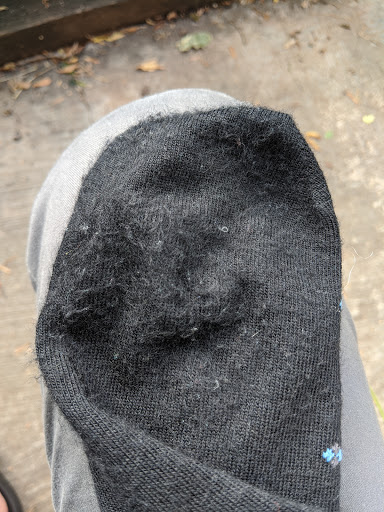
Today was a kind of difficult day. Halfway through isolation, I can feel claustrophobia and agoraphobia converging. I am sick of wearing socks all the time. It’s too cold to take them off though. I check the mailbox in them. My toes are red and I’m not sure why.
When restrictions are eased and we can return to competitively stomping the footpaths, things will be tougher. Many of us will have to put up with old socks for longer, as money will be tight..
I have confidence in the cheerful power of necessity and the ability to find pleasure with each other in more humble ways, at least having less choice of socks can be a good thing. I don’t run far with this ‘poor people are happier’ classist manipulation though, and there is more at stake than vague statements about general cheer. I need new socks and when it comes to their design, manufacture and sale I am earnestly worried.
Will we be only left with socks sold by the supermarket duopoly and Amazon, who are doing better than ever, tying up every corner of ‘essential’ supply chains? Will people stop buying higher quality socks and decide that they can’t afford to support local sock-makers? Will small retail already be wiped out for good by the time we’re back outside? Amazon is looking for hundreds of thousands of new employees while others are getting laid off in the millions. Soon we’ll all have the same shitty sweeping arrow logo on our socks.
Will we have to start taking jobs we wouldn’t have otherwise? Will the next decade be one of low prospects and good but depressing music? Will opportunities feel like being offered wet socks, as we are weaned off social security payments with a dash of Thatcherite patronising? Will we be asked to ‘do our bit’? Do our bit for what, we’d ask. What does my bit contribute to? Better socks for future generations on a dead planet? Affordable socks for everyone? Or gold-plated socks for rich dicks to wank into?
The hospitality, live entertainment and tourism industries have been temporarily wiped out, despite being essential in their own way. They thrive on differentiation and therefore do not tend to form overcapitalised monopolies as easily as retail. Everyone stuck at home is relying on some form of platform entertainment, and Netflix is now bigger than ExxonMobil. For out of work theatre and musicians however, there’s no substitute for a live performance to knock your socks off, and a virus agrees.
I am worried that for every person I know who claims to be fairly unaffected, and even enjoying this time, there are many who have had their lives made significantly worse, stuck inside for now and out of work for the foreseeable future. I need look no further than the United States, but I must look around it’s self-obsessed girth also to Ethiopia and Brazil. I realise how homogenous and privileged my contacts and I are, and how the socks I walk in are coloured vanilla by that.
Today I took a moment to read about how many people are stranded in places they don’t want and can’t afford to be, running out of clean socks and money. If it were as simple as borders closing for all, a government would have to take legal responsibility for stranded foreigners, but most were left hanging by companies. ‘Private’ airlines and travel insurers bailed on customers immediately, with a waiveable duty of care when it was needed most (read the conditions). Portugal extended support for its citizens to any foreigner left in the country, a highly reasonable and prescient proposition. I can imagine multi-lateral agreements in the future providing this kind of assurance. For now though, the great immigrant nation of Australia ‘drew the line somewhere’ at permanent residents and up, meaning that temporary visa holders were left very far from home without socks on their feet.
Lastly, I reflect in hindsight on the positive character and professionalism of airline staff, hospitality personnel and patrons who I met on the way back, many of who were all stressed up to the neck about making it home and about to lose their lives’ momentum. I’ve seen a lot of goodwill pouring out of transitory people who might on any other day have disregarded each other. It felt almost old-fashioned, yet futuristic because the respect was pan-racial, and pan-national. Class – well, we’re not there yet, but it was classy. I felt like bowing when someone stood by a door waiting for me to pass. ‘Bless your cotton socks’ I would say.
DAY 9
SPASMS OF DISASTER
Exactly seven hundred years ago, the bubonic plague was catapulted over the walls of besieged medieval cities by invader Mongol hordes. The bacterium went on to completely engulf Europe through further wars and trade, laying low over a third of its population. Medieval Europeans didn’t make a causal link to the invaders but to the supernatural and astrology. Sadly, the user’s manual didn’t travel with the disease.
With Pasteur’s identification of killer microbes and the later invention of antibiotics, quarantine and disease control became common practice in the world of trade and war. It still did not stop the influenza outbreak in 1918, which was kept silent by the combatant states of WW1 for the sake of ‘morale’ (sound familiar?). Only neutral Spain initially reported its existence, hence ‘Spanish Flu’. By the time it was acknowledged, the world was completely infected and flying blind. One hundred years later, that initial lag time still makes all the difference.
How is it that in the age of instant communication, persuasion and gratification, a virus wafting through the air from one slow-moving flesh bag to another can still outstrip the pace of information?
Well first of course there’s the initial cover up. But it is also testament to our mobility systems – planes haven’t changed much since the 1960s but software and management procedures have improved exponentially: before corona (BC) a million or so people were in the air at any one time, and it took me just 15 seconds to find out that fact.
At the same time the wide spread of corona lays bare how clunky and old mobility and communication systems are too. Thousands of people were packed into lines at airports, being held together in case of a few of their number were infected, certainly infecting each other in the process. Airports were used as a solution to the problem of airports, an absurdity in-line with post 9-11 airport security and post-Davos duty free shopping corridors. In many ways hyper-mobility was already looking pathological.
Critical time lags exist in epidemiological tracking everywhere: Between brain and screen (cognition time), between infection and symptom (incubation time), between knowing and admitting (authoritarian time), between reading the news and taking it seriously (killing time).
The combination of these critical lags meant that planes and cruise ships moved, in effect, faster than the right kind of information. A virus moves in effect faster than light speed when not enough people are tested. The lag in its symptoms helps it go further if not faster.
The spread of coronavirus in an initially unpredictable (and in hindsight, commonsense) way shows how data and information are constructed selectively and how extraordinarily incomplete a picture they provide as ‘knowledge’. Intelligence is furnished and recursively constructed by data and information, but also judged by its ability to define what data and information are most useful to construct in the first place. This helps it (recursively) and to direct sensing to the most relevant places.
Like an expert with no life experience, datasets and informational models can be very convincing, and they can also be rather idiotic. They usually plug into analogue models to stay relevant. For example, the coronavirus infection map is a mercator projection of the world measled with red emergency dots. It is a safe bet for universal comprehension yet it also demonstrates how comprehension can also be the enemy of complexity. In this case the mapping just one intersection (of two species) is fit for ‘where’ and ‘when’ analysis, but certainly not ‘how’ or ‘why’.
Even the where and when have large gaps and flaws. Efforts to stop the spread of coronavirus are stymied by limits in sensing, let alone fake figures. The more testing that a country has been able to perform, the better they are able to direct their efforts, but also the worse the situation looked for them. Resistance to certain comparisons (higher death rates for example) become immediately political. The tests, however, are not complicated, nor are the labs in which they are sent to, but in many cases the logistics of their manufacture and reporting have fallen short of even a standard online shopping service.
The stock market takes almost no time to detect and respond to changes. If anything, it is too speedy which is why trading is automatically frozen when too many stocks fall too quickly. The data centres of large investment banking firms are literally located right next to stock exchange servers in New Jersey. ‘Mom and Pop’ investors in the US are considered to be seriously disadvantaged in this business owing to their latency speeds, which differ by just milliseconds.
How can we apply these levels of sensing, amazingly slim reaction times and innovativeness to crisis scenarios? I know, ‘it’s money etc’, but health, social cohesion and ecological value underwrite all value. Calling them ‘too big to fail’ would be the understatement of the century.
DAY 10
PR©
It’s time to stop equating the People’s Republic of China with a cohesive race, culture or even interest, for they are not the same, and coincident at best. The PRC claims to represent and defend the interests of ‘the Chinese people’ while in actuality being the greatest wholesale threat to many of them. Over here, shameful attacks on Asian-Australians, many of whose backgrounds are not in the PRC let alone part of the regime show that the worst of us are actually not being discriminatory enough.
Donald Trump, the distillation of Reagan’s vapid fame, Clinton’s mendacious sleaze and Bush’s terrifying stupidity, called coronavirus a ‘Chinese virus’. He was ‘called out’ for being racist and ‘politicising’ the illness by many sides. The PRC has shown itself to be more than happy to weaponise this wokeness.
The intention of the USA’s orange Nero was buck passing but if he had said ‘PRC virus’ he actually would have been pretty close to the mark. This illness does not just happen to have emerged from the territory of the PRC. It does not just happen that patient zero is an unfortunate national in the wrong place at the wrong time. This outbreak, even an accident as it likely was, was directly exacerbated by the actions and inactions of the PRC. This is the second major pandemic to emerge from the gigantic nation in the last two decades, from roughly the same place and under roughly the same conditions. It was handled with the same level of criminal negligence and paranoid silence as SARS. Its smaller neighbours including those ‘no relation’ SARs that the PRC claims outright: Taiwan, Macau and Hong Kong; learned much from the previous outbreak and applied them to great effect. In the meantime, the CCP demonstrated that it had learned new skills for tracking and controlling its own citizens – strategies which it has been developing anyway and for other well-known reasons.
It has been exceedingly rare that most nations in recent time would take the PRC to task, and at least not without the precedent and support of an increasingly bratty United States. A progressive UK think tank has gone as far as to encouraging suing the CCP for trillions to account just for government stimulus and welfare packages in countries affected by the coronavirus pandemic. Australia has called for an international investigation into the origins of the virus and been quietly threatened with sanctions by PRC ambassadors as a result. Setting aside the old cold war fears of military power and expansionist goals, the CCP is more likely to wield their classic ‘hurt feelings’ tactic, portraying itself solipsistically as a victim of specifically anti-Chinese sentiment.
The regime has, at the time of writing, frozen reports of new cases of coronavirus and are encouraging people to go back out to their normal lives in some cities. The death figures for Wuhan were quietly ‘revised’ up 50%, and the overall death proportion of 0.33% of infections is simply not possible. Again, it was Trump who took this on directly, a sad reflection on who is allowed, or even expected, to be outwardly critical. Many Americans’ fear of the explodingly influential single party state, and their inseparability from it, would explain a good deal of Trump’s popularity and populist movements generally. They are not just skin deep in concerns of ideological racism but also real concerns about the disappearance of US industries and self-sufficiency.
Being taken seriously as a world player is an obsession of the CCP, just as it was for the ‘Meiji-era’ Japanese in the late 19th century. Over a few busy decades the Japanese largely succeeding in convincing European colonists that they had equals in Asia. They proved this by invading ‘inferior’ neighbours (i.e. the very same China as well as Korea and Taiwan), using European military technology and colonial strategy that it had sent delegations to deliberately learn.
China was completely ravaged by the resultant Japanese atrocities and civil war afterwards, and the victorious PRC has had many an axe to grind since, many of these legitimate. It has also, sadly, had a good go at beating up on small neighbours like Tibet and the Uighur’s of Xinjiang, all the while claiming that resistance to aggressive ethnic replacement tactics is nobody else’s business but ‘China’s’. The PRC claims a meta-regional mandate in continental East Asia, on matters of progress, culture and that most sinister of words: ‘harmony’. As it reaches into Africa and Latin America, it might appears to do so non-ideologically in the name of business, but of course there is no such thing. Business between dictators and a ‘people’s republic’, between the needy and a needful giant. There is no politics like a-politics, and there is no commercial nihilism like the PRC’s a la carte communism.
The People’s Republic of China is not a new world leader emerging to replace the United States. It’s economy is soaring thanks to a dynamic manufacturing sector, but it is still a homogenous pariah state that no-one feels like they can afford to offend. In the long term, though, most countries can’t afford not to offend the PRC, and the PRC cannot carry on its mission without the ideas and names of its trading partners. Brand PRC is at an all-time low, not just amongst Europeans, Africans and Americans but also amongst many Chinese people who justifiably want to be proud of the great leaps forward made by ‘their country’ (unless they are in Taiwan, Hong Kong or the old Cantonese diaspora).
The clever and dreadfully simple ability of the PRC to avoid multi-lateral resistance to what remains of its ideology (i.e. it makes everyone’s stuff and gets offended easily) has Henry Kissinger licking his dodgy slug lips all the way to his consultancy’s bank account. The PRC’s practices of repression, espionage and bullying are so clear to the rest of the world yet few are willing to risk their manufacturing base to really take them to task. This betrayal of free-thinkers in Asia provides a false sense of ascendancy – of the PRC as a legitimate alternative of governance on a menu where democracy is but one dish and free press is only a side. Throwing culture, race, people, ethnicity, state and regime into one mix makes whatever the PRC is proposing a very smelly thing indeed. The new bully on the block has failed to stir hearts and minds and has reached only the lungs.
DAY 11
HUNTING FOR EXTERNALITIES
It makes a great deal of sense to respond to coronavirus as a health crisis in need of health expertise, and to the climate emergency with environmental expertise. That said, the overlaps between the two are ripe. The causes of both are related. Both require similar levels of collective thinking and macro-political action that are conscious and adaptive rather than residual and projective. The solutions they look for are comprehensive rather than merely populist.
So far, reactionary politics has responded to each crisis in piecemeal ways, yet the internet at least agrees that “climate change needs corona’s PR”. The virus does seem to be ‘blessed’ with a singularity that appeals to our reptilian attention spans. It can be tracked and understood in the abstract, like a simple game with significant outcomes. Climate emergency, on the other hand gives us this vaguely overwhelming feeling that we’re already fucked.
It is difficult to put forward comprehensive solutions to climate change that are as sweeping and simple as telling people to stay at home, and the threat of corona is easy to sell: You get a fever, you cough, you can die or kill others just this week. Climate change and ecosystem destruction on the other hand occupy a terrible zone of removal from everyday experience in the wealthy world. When major polluters start feeling its scale it will already be upon us, like Nina Simone’s Sinner man.
The coronavirus is the result of incursions into wrecked remnant habitats, but the outbreak is not ecological revenge nor poetic justice. Diseases are actually not population control for humans, but apparently have the opposite effect: A high child mortality rate is directly linked with rapid population growth. If a family believes that their children will have a good chance of survival, they will have fewer children, and populations will stabilise. This has most recently occurred in much of Asia, as the late statistician Hans Rosling used to delight in narrating.
Extended to a general social outlook; confidence and optimism for a future where we will succeed in solving today’s biggest problems must be a primary factor for investing in it in first place, with emotions and with cash. On the other hand, desperation leads to exploitation.
The incredible amounts of material waste and energy used by the health industry are really non-negotiable. Health has proven itself possibly the steepest value item of liberal democracy: We may live in money-grubbing times, but they are still utilitarian and based on confidence in the desperate continuity of human life nonetheless. The million-year question is if this can be extended to non-human life – so that we may last a million years.
Ecological destruction and climate change are still for the most part not priced into markets, and resistance to doing so (e.g. with a carbon price) is not the product of lighthearted ignorance about its negative impact on business. Ecosystems and resource wells are the mother of all market externalities, targeted deliberately as the best places to find profit. International capital follows this logic at the overlapping expense of both ecosystems and people that live(d) in them. In other words, the market does not wish for misery, but its mechanics are perfectly oriented towards it. The pangolin-hunting forests in Hubei are a perfect play-by-play of this.
I admit that conceptualising multifarious ecological exhaustion as ‘externalities’ relies on an overly human-centric approach to ecosystems with intrinsic value, as well as perpetuating the conceptual separation of ‘environment’ from ‘us’. It is, however, necessary, as the worst thing that we can do for most ecosystems is to live in them. Most ‘green’ people feel uncomfortable with expressions of new artificiality like GMO, vaccinations and AI, presuming that technology takes ‘us’ further away from ‘nature’, even though they often shut down real solutions to a gluttonous super-harvest of which lifestyle greenies disproportionately reap.
Connection to soil, other species and artificial intelligence are able to bring measurable improvements to physical and mental health. Trillions are spent on the ‘health industry’ each year and it comprises an extremely varied set of agendas like universal healthcare, genome research, big pharma, medecins sans frontiers and alternative practitioners. They all claim some special mandate to improve and prolong life (especially prolong), yet are still lacking in incentives to create a nexus of high tech artificiality, physiology, and ecology.
I am not just arguing to treat patients with augmented air, smart moss and patting AI kittens, although those ideas do carry some appeal. It is most important first to treat environmental issues as health issues and vice versa. A conspiracy of the two might help capture and price more externalities and make both seem less…optional.
DAY 12
DIG UP, STUPID!
After an initial drop in greenhouse gas outputs during the GFC, carbon emissions quickly spiked afterwards, superseding previous levels by up to 5% as government investments and tax breaks for ‘business as usual’ were considered to be a safer bet than investing in new technologies. Germany pushed the EU into austerity and the People’s Republic of China drastically increased their investments in renewable energy generation in the following years, playing the long game.
Countries not playing the long game are about to start paying for it dearly. Russia, amazingly enough, met it’s Kyoto protocol targets immediately when it was signed in 1997, because Russia used the pre-1991 USSR figures as a starting point. Effectively an oil and gas state since then, it has attempted to increase other industries like agriculture but too little too late. Thanks to the collapse of its oil pricing agreement with Saudi Arabia and an unplanned pandemic, they will feel the pain of this crunch almost immediately and it will endure. The Australian government, meanwhile has taken the opportunity to buy up huge quantities of cheap petroleum as a national reserve…except that it is all stored in the USA. In the future it will be difficult to comprehend why renewables were ever considered a ‘less safe’ investment, on investment grounds alone.
In the United States, a ‘Green New Deal’ has been the consistent platform of the ‘untenable’ Greens party in the US, who are not-unfairly criticised for being unable to bankroll any of their proposals or provide platforms for other issues such as national security.
The original New Deal with its ‘three R’s: relief, recovery and reform’, was an intelligent and timely achievement. Owing to immigration and new technologies in the 1920s, the USA had extremely high human capital and loads of local resources for industry. It could recoup huge gains from all of its spending in the decades to follow, thanks also to its provision of European allies during the war, and the creation of large new markets through Marshall Plan and the occupation of Japan and South Korea. Geopolitical events were very much on its side, and it struck out with the argument that global wealth and opportunity were no longer a zero-sum game – well, when you take the planet out of the equation.
Today I take a minute to imagine bailing out the cruise ship industry. I attempt to double down on why this is such a repellent idea to me, besides my obvious distaste for trades in physical and mental obesity.
Cruise operators are effectively disqualified from receiving bail-out money due to registering their operations ‘offshore’ to avoid paying taxes and adhering to ‘tourist generating’ countries’ labour laws. Beyond that, and aside from now being proven as perfect incubators of disease, the other gross and objectionable qualities of cruising are highly subjective. It is difficult to draw a line above it, when most industries can be argued to be mixing some cocktail of delight and misery together.
There have been liberal amounts of slack in the categorisation of ‘necessary’ services during lockdown, and categories of commerce are ‘felt out’ case by case at high level. At one point the ‘essential’ encompassed things like hairdressers, churches and sports. Takeaway food joints remained open in Australia but not in New Zealand. Schools were contentious everywhere from day one. Mechanics stayed open, yet so did shops selling video games.
Core necessities, even in commerce, are difficult to self-define without making a total stocktake of values and national story, which is why there have been so many mixed messages from the top in more fractured nations. What ‘need’ does going to the hairdresser fulfil? What ‘need’ do children have to go to school? What ‘need’ do we have to drink alcohol? What civil liberties are ‘needed’? All of these can be argued convincingly in one way or another, and extreme lockdown scenarios in Southern Europe and East Asia show the buck stopping with good old food, water, gas and electricity. When aiming a bit higher than that for perpetuity, being able to visualise and discuss where the ‘line is drawn’ is, well, necessary.
In a perfectly high-functioning consumer economy, all follies of choice are equally essential, and thus is the promise of UberEats and Netflix and Amazon. This logic is not in the least bit conceptually weakened by the stark reality of millions of precarious warehouse workers and delivery riders. The goods are their own proof.
The current massive-scale underwriting, investing in and bailing out of private sector players has however forced an opportunity to be much more ideologically selective about what is worth supporting, and what is not. This is taxpayer money, after all. This is an obvious time for investment in future-proof infrastructure such as renewable energy, public transport and communications; but there is also a very high risk and history of crisis-based budgetary decisions that are made too hastily and with a short-term view of ‘what works’.
To miss this opportunity could be terminal. The payoffs for large-scale investment in future systems are usually too slow for current political cycles to benefit from them, and a great deal of consensus is needed for them to pass. This is why big national moves used to be concentrated during crises – leaders are often in place for longer, have a larger mandate, wider support, and recognise the heightened possibility of leaving a legacy. It is important that we track pay outs closely and carefully – Yuval Harari has suggested that this is the perfect opportunity for surveillance – of governments by the public.
There’s a nice saying about how infrastructure is what you don’t notice until it fails. Perhaps replacing ‘fails’ with ‘tested’ might make it less tragic and inevitable, but testing the value of infrastructure is tricky. The metrics of total failure are more obvious than the metrics of slow decline or partial failure. Even the metrics of success are far more contextual and subjective than failure, for they must pay respect to changing ideas of what ‘necessary functions’ are most necessary, as mentioned above.
Cities, no matter their local systems, resources and priorities, are connected in competition with one another across national boundaries as long as the planes fly and the undersea cables hum. Infrastructure is national and inter-national, and sometimes trans-national. Cities together are now the expression of an adversarial spatial economy that digs up increasing amounts of ground while appearing on the surface to be less located and more transferrable than ever.
Now though, the covid map doesn’t just show the spread of a disease, but the results of a different kind of litmus test: The ability for capital and informational transfer. That is, the physical separation and informational co-location of world cities is being highlighted and thrown into doubt at the same time. This is significant because ‘necessary’ production is often defined by export markets, at least as much as local consumption, and certainly more than local ‘value’. It is this subjective latter quality that might stand to gain some ground here: It possible that placed-based valuations can take more of a front seat in industry without firing up planes for tourists? This is an incredibly complex challenge.
Working with uncertainty is a necessary prerequisite in a multi-polar world at relative peace but with unsustainable material-ecological conditions. The paradigm of ‘wicked problems’ has not been developed because the world has become trickier per se: problems have become trickier because we will no longer accept the necessity of 30 years wars, genocidal colonisation or viewing infectious diseases as god’s work. Public investments should reflect increasing standards of humanism, trans-humanism and environmentalism and not be seen merely to achieve the purpose of fiscal stimulus.
Our inability to predict a complex future and plan for unprecedentedly high standards is no barrier to planning, but it does require a subtle and difficult shift towards a public sector that is responsive rather than reactive, and can be easily surveilled itself.
DAY 13
GET OLD, KILL TIME
This pandemic has been killing the elderly disproportionately and I suspect that the delay in taking it seriously results partly from this caveat. A growing tally of medical staff casualties in the PRC, Iran and Italy raised the bar of loss, while whole nursing homes were being wiped out. Doctors and nurses are particularly valuable and heroic right now, but they are also highly trained, generally able-bodied and productive members of society. This is a victim profile that pits an economic loss argument against another one. A market does not value an elderly life though, beyond the products and services offering to extend it at all costs. It flatly accepts the fact of all facts – that life eventually extinguishes itself and becomes quickly unaccountable.
I have however been surprised to see how unquestioningly most governments have suspended economic activity in light of health advice. Of course many leaders are still trying to keep confidence in ‘the economy’, but inevitably, at stages three and four of lockdown, the priority of governance, economy and society looks quite different to the typical charges against the neoliberal story. Is the military-industrial complex actually built on top of some bigger platform that follows a no-less terrifying ‘humane’ logic? Or is the ‘health-industrial complex’ just a different head of the same beast?
For many elderly people, social isolation has increased during this time, causing a great deal of distress on top of the risks of infection. At the same time, the rest of us have begun to emulate similarly homebound routines to our elderly neighbours. We put our slippers on and leave them on all day, easing off our normally ‘busy’ routines, spending more time in the same spaces and venturing out for rare and appreciative walks, wary of other bodies and the safety risks posed by them. We spend more time alone with our thoughts and talking to our pets. We make long phone calls and catch up with old friends, reminiscing on former travels and adventures. We may chew up a lot of this time on Instagram, but there is still enough time leftover to witness the joys and sorrows of the late stages of life.
Lockdown is an instructive lesson in learning how to pass time contentedly, rather than ‘killing’ it impatiently. The elderly in individualistic societies usually find themselves detached from a world which offers them but a skerrick of former opportunities. This is nothing however, compared to the ultimate FOMO rushing towards them: death itself, feared not as the pain of dying, but as the prospect that on the day after we die everyone will wake up and continue on without us.
I read that there is a great deal of anger in Sweden because aged care homes have become hotspots for coronavirus deaths, owing to widespread neglect and sloppy hygiene practices within. I remember these sorts of stories being already commonplace in privatised aged care institutions – patients being beaten, underfed and over-medicated. Their business models favour keeping people alive in a decrepit state with the least demand on resources, and accelerating their decrepitude. Swedes are justifiably outraged, though their twinge of surprise is perhaps a bit confected, given the general social neglect of the elderly that enabled them to be there in the first place.
New social housing models in Sweden were aiming to turn this around, combining student accommodation with aged care facilities, subsidising the ‘cost’ of both in the process. The elderly, for better and for worse, are a repository of lived history and their loss is not best captured by a tally algorithm from John Hopkins University, but by the silence of their presence in the city, the stories that aren’t being told and the perspective that these stories bring to the young and self-obsessed. Let’s be honest, many of these stories are couched in a lot of tedium and minutiae that don’t hold much attraction in the attention economy, but being sucked into a hole of forgettable history can also remind you that facing down boredom is just as important as staying informed – after all, you’ll be up next.
In ‘the three body problem’ trilogy, author Liu Cixin invents a game-world where the scientist-protagonist must contend with a planet plagued by the movement of three suns. In orbital mechanics this is not a solveable problem, therefore entire civilisations are built up successively on this planet without the knowledge of when a long cold or extreme heat will destroy everything they have created. AI citizens ‘desiccate’ themselves and are stored in warehouses for a length of time that is always different. Player avatars attempt to find mathematical models that will allow for strategic planning rather than each successive society replicating itself to the same end. The aim is to have generational knowledge ‘jump’ over a period of stagnation and crisis by using a model that persists. We are lucky enough to not have to solve for this jump, because we have a stable sun and 3-4 generations alive at the same time. Or do we? To make this really the case we have not to jump across blocks of time, but into them.
While lockdowns and travel bans disrupt our careers and lifestyle plans, many of us are experiencing higher levels of idleness and unpredictability than ever before. We grew up in a time of unprecedented stimulation and mobility. Now, in experiencing a free-fall of life expectations as we are, this is the best time for history, both the apparently meaningful and especially the bland minutiae. Perspective comes from passing time, and nothing comes from killing it.
DAY 14
TOMORROW’S FREEDOM
Tomorrow is the day of my ‘release’ (‘self-release’ doesn’t sound quite kosher) and I have been concerned about what I might find out there on the street. Will I have emerged too late? Will the world already have changed, clumsily and reactively? Will there be zombies? Will there be large three-tone billboards of leaders whose incompetence has made no barrier to their popularly vested authority?
Civil liberties groups have been watching the augmentation of discretionary police powers, warning that they must be reduced in step with the inevitable end of the pandemic. Much like the ‘ongoing’ threat of terrorism however, the disappearance of this novel coronavirus does not in any way end the hypothetical ability for individual freedoms to be curtailed in future states of emergency like this, and some of the systems will surely be maintained.
I just read that liberty describes the ability to choose the kind of relationships you want to have, rather than doing whatever you want in spite of others’ interests. Liberty may be codified through the inalienable rights of the individual, but beyond certain unambiguous tenets it cannot be extruded literally to governance in general. That is to say, that only the most glib and unimaginative reading of libertarianism would and did motivate a bunch of armed incel men to storm the Capitol of Michigan to protest lockdown.
One would think the libertarian tradition is strong in Australia but there is a fundamental difference between here and it’s rightful American home. In Australia self-sufficiency is infused with the spirit of labour movements rather than transcendentalist ideals. The pure irony of American idealism is that it is easily corruptible and ‘open to interpretation’ (and cretinously literal readings) than a materialist tradition, be it Marxist of colonial utilitarianism. It may be called profane, cynical or bolshy but can be more easily measured and enforced by funding and policy.
This is not to say it is inherently better of more moral per se. Panic buyers and hoarders are pathological capital materialists doing what they do normally, but better. The fact that the focal point of a crisis and ‘normalcy’ are the same place for them (the supermarket) says a lot about the futility of self-preservation in global crises as well as illustrating the structurally homogeneous products of ‘liberty’ that are not qualified collectively, nor spatially, in the first place.
It is difficult to tell whether command and control governance has proven more effective in tackling the pandemic, though on face value it seems partly true, as the ‘free world’ was initially hardest hit. It is probable that authoritarian states are less squeamish about controlling personal movement and punishing indiscretions, though it is just as probable that they do not release realistic figures either. Furthermore, command and control has proven once again to be the sordid source of cover-ups, gagging and neglect that unleashed the pandemic in the first place.
Extra individual freedoms also bring extra anxieties, but these anxieties can be accepted willingly as the price of entry to a world where governments are not beyond question. To some degree me must take on the emotional burden of self-isolation and undertake it willingly, just as governments must explain to us why it’s a good idea to do so. If this relationship or abstract trust breaks down, citizens must act unilaterally and governance is weakened – as many self-locked down communities in Brazil have demonstrated. Sometimes they have acted with the support of state governors, and sometimes without.
The epithet ‘to take responsibility’ is perhaps so overused that’s its connotation has become watered down. The ‘taking’ does not suggest a kind of obligation to authority, but the contrary: Responsibility is taken when it is not offered in the first place, and all that is required is a tacit silence. Responsibility is supposed to be seized in an environment of false consensus and ineffectiveness as well as when it is aligned to a useful consensus.
It is a tricky call to (mental) arms. There is no doubt that there are and always will be large numbers of conspiracy theorists and other credulous ‘skeptics’ who automatically resist the imposition of new rules while being arbitrarily selective of the old ones. These people yell the loudest and read the above paragraph as suiting their chosen cause, at once malleable and stubborn.
Despite these irritating voices, it has been a great relief to discover the level of trust in scientific rationale on the political stage in the midst of a great deal of confusion and complexity. ’Giving up’ personal liberties in order to be safe from something dubious and unseen, as it turns out, is fairly palatable to most people if there is some perceived scientific credibility to it. The dumb capriciousness of authoritarian regimes, be they religious, fascist, communist, capitalist or some seamless combination of the above (as they usually tend to be), does not fare well in the open air of constant scrutiny, figures and effects.
How can we keep scientists in these echelons of the political domain in perpetuity, without installing technocrats of equal caprice? The climate emergency has not emerged as linearly as the coronavirus, and so its effects will be more runaway and difficult to control over time. It already has momentum and it will not be able to be mapped on a Mercator projection of the world in red measles dots whose significance is clear to a child. There are many, many maps of the climate emergency, each insufficient to capture the complexity of ecological interrelations and trophic cascades in local ecosystems and planetary liquid dynamics.
Let us hold on to that runaway feeling we had when we didn’t know how bad coronavirus would get and wondered what sort of world we would end up in. This was before the exponential curve started to slow. Let’s remember how glued we were to that curve, and imagine what it would be like not to have one, or to have one and ignore it. But we don’t even have to imagine that, do we?
 PAUL VAN HERK